|
| |
 Home >>
The Crusades >> The
First Crusade >> Introduction
Home >>
The Crusades >> The
First Crusade >> Introduction
 The
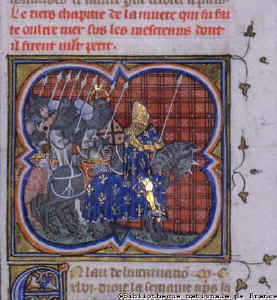
Crusades began formally on Tuesday, November 27, 1095, in a field just outside
the walls of the French city of Clermont-Ferrand. On that day Pope Urban II
preached a sermon to crowds of laypeople and clergy attending a church council
at Clermont. In his sermon, the pope outlined a plan for a Crusade and called on
his listeners to join its ranks. The response was positive and overwhelming.
Pope Urban then commissioned the bishops at the council to return to their homes
and to enlist others in the Crusade. He also outlined a basic strategy in which
individual groups of Crusaders would begin the journey in August 1096. Each
group would be self-financing and responsible to its own leader. The groups
would make their separate ways to the Byzantine capital, Constantinople, where
they would meet. From there, they would launch a counterattack against the
Seljuk conquerors of Anatolia together with the Byzantine emperor and his army.
Once that region was under Christian control, the Crusaders would campaign
against the Muslims in Syria and Palestine, with Jerusalem as their ultimate
goal. The
Crusades began formally on Tuesday, November 27, 1095, in a field just outside
the walls of the French city of Clermont-Ferrand. On that day Pope Urban II
preached a sermon to crowds of laypeople and clergy attending a church council
at Clermont. In his sermon, the pope outlined a plan for a Crusade and called on
his listeners to join its ranks. The response was positive and overwhelming.
Pope Urban then commissioned the bishops at the council to return to their homes
and to enlist others in the Crusade. He also outlined a basic strategy in which
individual groups of Crusaders would begin the journey in August 1096. Each
group would be self-financing and responsible to its own leader. The groups
would make their separate ways to the Byzantine capital, Constantinople, where
they would meet. From there, they would launch a counterattack against the
Seljuk conquerors of Anatolia together with the Byzantine emperor and his army.
Once that region was under Christian control, the Crusaders would campaign
against the Muslims in Syria and Palestine, with Jerusalem as their ultimate
goal.
The Crusading Armies
In its broad outline the First Crusade conformed to the
scheme envisioned by the pope. Recruitment proceeded apace during the remainder
of 1095 and the early months of 1096. Five major armies of noblemen assembled in
late summer, 1096, to set out on the Crusade. The majority was from France, but
significant numbers also came from southern Italy and the regions of Lorraine,
Burgundy, and Flanders.
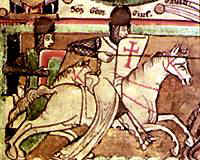 The
pope had not foreseen the popular enthusiasm that his Crusade would arouse among
ordinary townspeople and peasantry. Alongside the Crusade of the nobility
another one materialised among the common people. The largest and most important
group of popular Crusaders was recruited and led by a preacher known as Peter
the Hermit, a native of Amiens, France. Although the participants in the popular
Crusade were numerous, only a tiny fraction of them ever succeeded in reaching
the Middle East; even fewer survived to see the Christian capture of Jerusalem
in 1099. The
pope had not foreseen the popular enthusiasm that his Crusade would arouse among
ordinary townspeople and peasantry. Alongside the Crusade of the nobility
another one materialised among the common people. The largest and most important
group of popular Crusaders was recruited and led by a preacher known as Peter
the Hermit, a native of Amiens, France. Although the participants in the popular
Crusade were numerous, only a tiny fraction of them ever succeeded in reaching
the Middle East; even fewer survived to see the Christian capture of Jerusalem
in 1099.
The
Council of Clermont -->
| |
|